Every change that measurably altered what AI search cites, or
how visibility is measured, from the first answer engine in December 2022 to
now. Google's algorithm history has been documented five times over. AI search
has no maintained record, so this is one.
24 entriesDecember 2022 → June 3, 2026Reviewed monthly
What qualifies as an entry. Only changes that measurably
altered what gets cited, or how visibility is measured. Product announcements
that changed nothing are left out, however loud they were. Each entry names its
primary source; entries resting on a single non-primary source are marked
Reported. Where sources conflict, the conflict is recorded rather than
resolved silently.
Each mark is one recorded change; taller stacks are months with several.
10 of 24 fall in 2024.
Select a platform to filter, or pick any mark to jump to its entry.
What the strongest evidence says
Two findings below carry more weight than the rest, on
sample size and method rather than on how often they get quoted. Both are
drawn to their method, because a number is only worth what its design can
support.
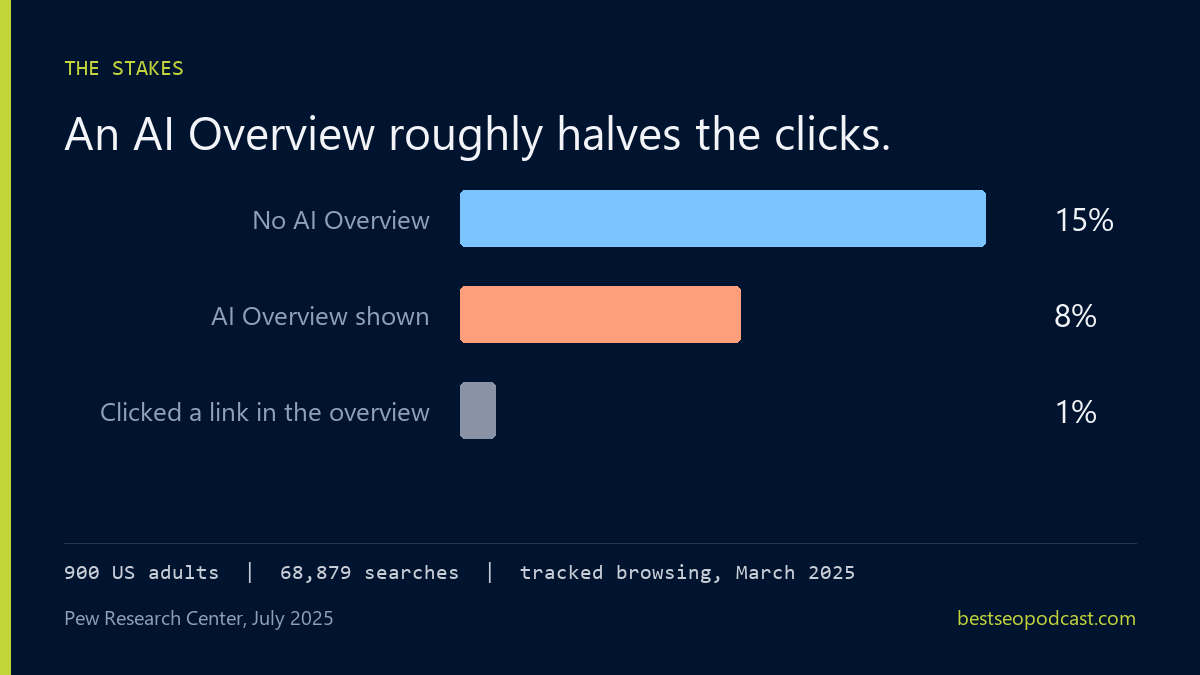
The stakesAn AI Overview roughly halves the clicks.
900 US adults · 68,879 searches
· tracked browsing, March 2025
Behavioural and non-commercial: real visits on real
devices, not a vendor model or a survey. That is why it is the click number
worth quoting.
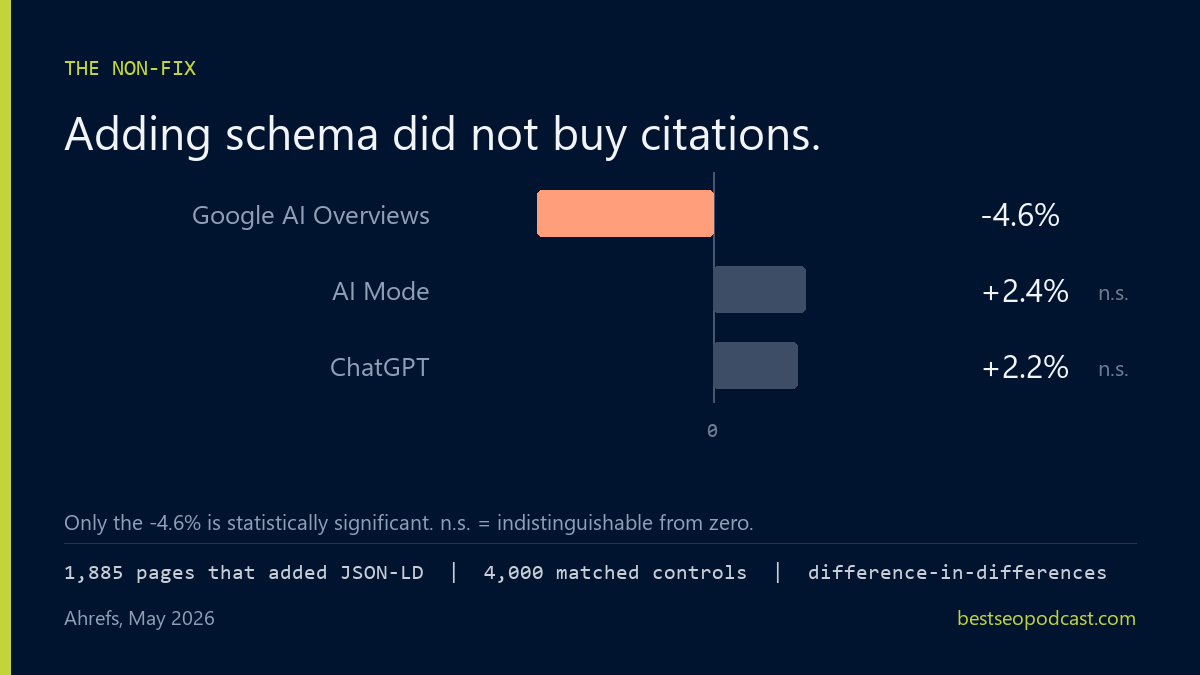
Only the −4.6% is statistically significant; the two
positives are indistinguishable from zero. A null published against the
publisher's own commercial interest.
Read together: the clicks contract, and the most commonly
sold fix does not measurably win them back. Schema still earns rich results and
resolves entities, it is the citation claim that the evidence does not
support. Both studies are entries below, with their limits recorded.
Both charts are free to reuse, including commercially, under
CC
BY 4.0, credit The Best SEO Podcast and
link back. Please cite the underlying studies as well; they did the work.
GoogleMethodology
# Google Search Console added generative AI performance reporting, the first first-party AI visibility data
Search Console gained a view reporting impressions within generative AI features on Search, AI Overviews and AI Mode, plus generative AI in Discover. Until this point every AI visibility number came from third-party sampling; this is the first data from the platform itself.
Note: Read the limits before treating this as solved. The report carries impressions only, no clicks, no click-through rate, no queries, and AI Overviews and AI Mode are combined into one "generative AI features" view rather than broken out. It is rolling out to a subset of sites. Claims circulating that data begins 2026-05-18 or that rollout is UK-only do not appear in Google's announcement.
# Ahrefs tested 1,885 pages that added JSON-LD against 4,000 matched controls and measured no gain in AI citations
Using a difference-in-differences design, Ahrefs measured Google AI Overviews at −4.6%, AI Mode at +2.4% and ChatGPT at +2.2% for pages that added schema markup. This is the strongest evidence available against structured data as an AI-citation lever, and it is notable for being a null result published against the publisher's own commercial interest.
Note: The study pooled schema types and sampled pages already receiving citations, so it does not directly test a never-cited page. Schema remains useful for rich results and entity resolution, the null is specifically about AI citation frequency.
# Seer Interactive measured AI Overview click-through recovering from 1.3% to 2.4% between December 2025 and February 2026
Across 53 brands, 5.47M queries and 2.43B impressions, Seer found AIO click-through rebounded 85% off its December 2025 trough, and that pages cited inside an Overview earn 35% more organic clicks than uncited competitors on the same SERP. The operative split shifted from "AIO present or not" to "cited or not".
Note: Seer has published at least three AIO CTR datasets pointing in different directions. Their earlier "-61% CTR" figure is still widely quoted as current despite this later recovery reading, always cite the dataset date, not just "the Seer study".
# Pew Research measured organic click-through at 8% with an AI Overview present versus 15% without
Pew tracked real browsing behaviour for 900 US adults across 68,879 queries. Users clicked a traditional result 8% of the time when an AI Overview was present versus 15% when it was not, and clicked a link inside the Overview about 1% of the time. It is the highest-integrity measurement of the zero-click effect because it is non-commercial and behaviour-based rather than vendor-modelled.
# Claude web search went global on all plans, adding a fifth major citing surface
Claude gained live web retrieval with direct citations, first as a US paid preview on 2025-03-20 and then globally across all plans on 2025-05-27. The global date is the one that matters for visibility work: it is when the surface became addressable for any audience rather than a subset.
Note: Trade coverage citing "May 6" refers to a different release, the developer API web-search tool, not the consumer feature.
# Google launched AI Mode, a fully conversational search surface separate from AI Overviews
AI Mode introduced query fan-out, decomposing one question into many background searches and synthesizing across them. Visibility in AI Mode therefore depends on matching sub-questions the user never typed, which breaks the one-query-one-page assumption that traditional rank tracking is built on.
Note: Three dates circulate for AI Mode and they are not interchangeable. It began as a Labs experiment for AI Premium subscribers on 2025-03-05; this entry is the I/O release to the general US population with no Labs signup. A wider 2025-06-27 rollout is reported but has no Google primary source.
# OpenAI launched ChatGPT Search, giving ChatGPT live web retrieval with citations
ChatGPT moved from answering out of training data to retrieving and citing live web sources. This created a second discovery surface with its own source-selection behaviour, distinct from Google's, and it is the surface most later citation studies sample.
Note: Two later dates matter more for reach than the launch itself, both recorded as updates on OpenAI's own page: all logged-in users on 2024-12-16, and everyone with no signup required on 2025-02-05.
# AI Overviews reached 100+ countries and over one billion monthly users
AI Overviews expanded to more than 100 countries and territories, serving over a billion users monthly across six languages, and the in-line links graduated from test to launch. This is the scale step that made AI citation a mainstream discovery surface rather than a US phenomenon.
# The llms.txt convention was proposed, and as of 2026 no major platform has confirmed using it
Jeremy Howard proposed a /llms.txt file to give language models a curated map of a site's content. It is included here as a documented non-adoption: no announcement from Google, OpenAI, Anthropic, Perplexity or Microsoft states that they consume llms.txt from third-party sites, and it has no measured effect on citation. Several AI companies publish one for their own docs, which is not the same as reading anyone else's.
Note: Listed deliberately. A chronology that records only what worked would leave practitioners implementing conventions no platform reads, a proposal that went nowhere is part of the record.
# Google took AI Overviews international and redesigned how it displays citations
AI Overviews launched in the UK, India, Japan, Indonesia, Mexico and Brazil. The same release moved supporting links to the right on desktop, added tappable site icons on mobile, and began testing links inside the Overview text, Google stated the link-display changes were driving higher traffic to publisher sites.
# Perplexity launched the first revenue-sharing program tied to being cited
Launch partners TIME, Der Spiegel, Fortune, Entrepreneur, The Texas Tribune and WordPress.com earn a share of ad revenue when their content is referenced in an ad-bearing interaction. Partners also received analytics into how their content is cited, making citation a publisher-side measurable quantity rather than an invisible one.
Note: The "$42.5M" figure common in trade coverage does not appear in Perplexity's announcement.
# OpenAI separated citation eligibility from training consent with the OAI-SearchBot token
OpenAI's crawler documentation states a site owner can allow OAI-SearchBot to appear in search results while disallowing GPTBot to keep crawled content out of training. The two settings are independent, which turned "should we block AI crawlers" from one decision into two with opposite consequences for visibility.
Note: Documented by, not introduced on. OpenAI's bots page is undated; the Wayback index first shows the token on 2024-07-26, the day after the SearchGPT announcement. Treat as an upper bound.
# OpenAI announced the SearchGPT prototype, and the OAI-SearchBot token appeared the next day
SearchGPT itself was a temporary prototype for a small group of users and publishers. Its lasting consequence is the OAI-SearchBot crawler token, which OpenAI's documentation first carries one day later, the mechanism that later let sites be cited without being trained on.
# Anthropic split its crawler into three independently-controllable tokens
ClaudeBot (training), Claude-User (user-triggered fetches) and Claude-SearchBot (search indexing) are controlled separately, and blocking one does not block the others. A site can refuse training while remaining eligible for citation, the same decoupling OpenAI made, from a second major lab.
Note: Documented by, not introduced on. The page carries only a rolling last-updated stamp; the Wayback index shows it live by 2024-05-01, which bounds the date without establishing it.
# OpenAI licensed display rights to News Corp's mastheads, shifting which sources appear in finance and news answers
OpenAI gained permission to display content from The Wall Street Journal, Barron's, MarketWatch, Investor's Business Daily, the New York Post, The Times, The Sunday Times, The Australian and others in response to user questions. A large premium corpus became preferentially citable by agreement rather than by merit.
Note: The widely-quoted "$250M over five years" figure comes from Wall Street Journal reporting and does not appear in OpenAI's announcement.
# Google launched AI Overviews to general US search, replacing the opt-in SGE experiment
AI Overviews moved generative answers out of Search Labs and into default US search results. This is the single most consequential event in the record: it is the change every subsequent click-through-rate study measures against.
# OpenAI and Axel Springer made licensed publisher content, including paywalled articles, citable inside ChatGPT answers
The first licensing deal to grant display rights rather than training rights alone. ChatGPT began showing summaries of content from POLITICO, Business Insider, BILD and WELT, including otherwise paid content, with attribution and links to the full articles. It established a citation channel that crawling cannot reach at any level of technical optimization.
# Perplexity documented PerplexityBot as a citation-only crawler that does not feed model training
Perplexity's crawler documentation scopes PerplexityBot to surfacing and linking sites in Perplexity results, and states it is not used to crawl content for AI foundation models. Blocking it therefore removes citation eligibility while yielding no training-data benefit, the first case where a blanket "block the AI bots" policy measurably cost visibility for nothing in return.
Note: Documented by, not introduced on. The live page carries only a rolling modified date; the Wayback index shows the predecessor URL returning 200 from 2023-11-26, which bounds the date without establishing it. Archive replay was unavailable, so the 2023 page contents were not read.
# The GEO paper (Princeton, Georgia Tech, IIT-D, Allen Institute) was the first peer-reviewed test of tactics for generative-engine visibility
The paper introduced the term "Generative Engine Optimization", built the GEO-bench benchmark, and tested nine optimization methods, reporting visibility gains up to 40% for the strongest. It remains the most-cited academic anchor in the field and was later published at KDD 2024.
Note: Verified against the full paper 2026-08-30; the per-tactic numbers in circulation are wrong. Table 1 is captioned "Absolute impression metrics" and its cells are absolute scores on a scale where no optimization scores 19.5, so the widely-quoted "+24.6% for citing sources" is a score, not a lift (the real relative figure is 27.7%, and the best method is Quotation Addition at 42.6%, which the paper rounds to 41%). The 19.5 baseline is ~1/5 because impressions are normalised to sum to 1 across the top 5 sources, making the metric zero-sum by construction. "Six engines" is a different, non-peer-reviewed preprint (arXiv 2603.29979); this paper tested two. Full working: /geo-paper-explained. A separate widely-repeated claim, "Semrush: schema +22%", appears to be a misattribution of this paper's expert-quotations finding.
# OpenAI published GPTBot and its robots.txt token, making AI crawler access an explicit publisher decision
Before GPTBot there was no supported way to allow or refuse OpenAI's crawler. Publishing the token turned AI training and retrieval access into a per-site choice, and made robots.txt a control surface for AI visibility. Blocking it is now one of the few verifiable causes of total absence from a platform's citations.
# Google introduced the Search Generative Experience at I/O 2023, putting generative answers inside the SERP
SGE placed an AI-generated answer block above organic results in Google Search itself, initially opt-in through Search Labs. This is the origin of the zero-click pressure that later CTR studies measured, the first time Google's own SERP answered the query in place at scale.
# Microsoft launched Bing Chat, the first mainstream search engine with a generative answer layer
Bing Chat put an LLM-generated answer above the link list on a major search engine and cited its sources inline. It established the pattern every later AI search product followed: a synthesized answer, with a small set of cited links beneath it, occupying the position organic results used to hold.
# Google announced Bard one day before Microsoft's Bing Chat event
Google announced Bard as an experimental conversational service, initially separate from Search. The separation matters for this record: Google's generative answers did not enter the SERP itself until the Search Generative Experience later that year.
# Perplexity released its answer engine, making the per-claim citation the default unit of an AI answer
Perplexity attached numbered source citations to every claim by default, rather than offering sources as an afterthought. It is the first mainstream surface on which being cited, not being ranked, was the unit of visibility, and it reached 2 million monthly active users within four months.
Note: Month only. Perplexity's own blog says "the release of Ask, our answer engine, in December 2022" without naming a day. The specific date of December 7 circulates widely but appears in no Perplexity primary source, so it is not used here.
Entries are verified against primary sources, the platform's own
announcement or the paper itself, rather than coverage of them. This matters
more than it sounds: two widely-repeated figures in this field trace back to
nothing. The claim that Semrush measured a 22% AI-citation gain from schema
could not be substantiated against any Semrush study, and appears to be a
misattribution of the 2023 GEO paper's finding about expert quotations. Search
Atlas's sample size circulates as both 5.5 million responses and 5.17 million
domain citations.
Nothing is deleted. When a later finding overturns an earlier one, the
earlier entry stays and is marked superseded. Seeing that a finding was
revised is most of what makes a chronology worth reading. Seer Interactive has
published at least three click-through datasets pointing in different
directions, and citing "the Seer study" without a date is now ambiguous enough
to be wrong.
Corrections are welcome and credited. If an entry is wrong, or a change is
missing, tell us.