Lesson 4 of 8
What actually moves the needle, and what does not
Of everything an agency could sell me, what is worth paying for?
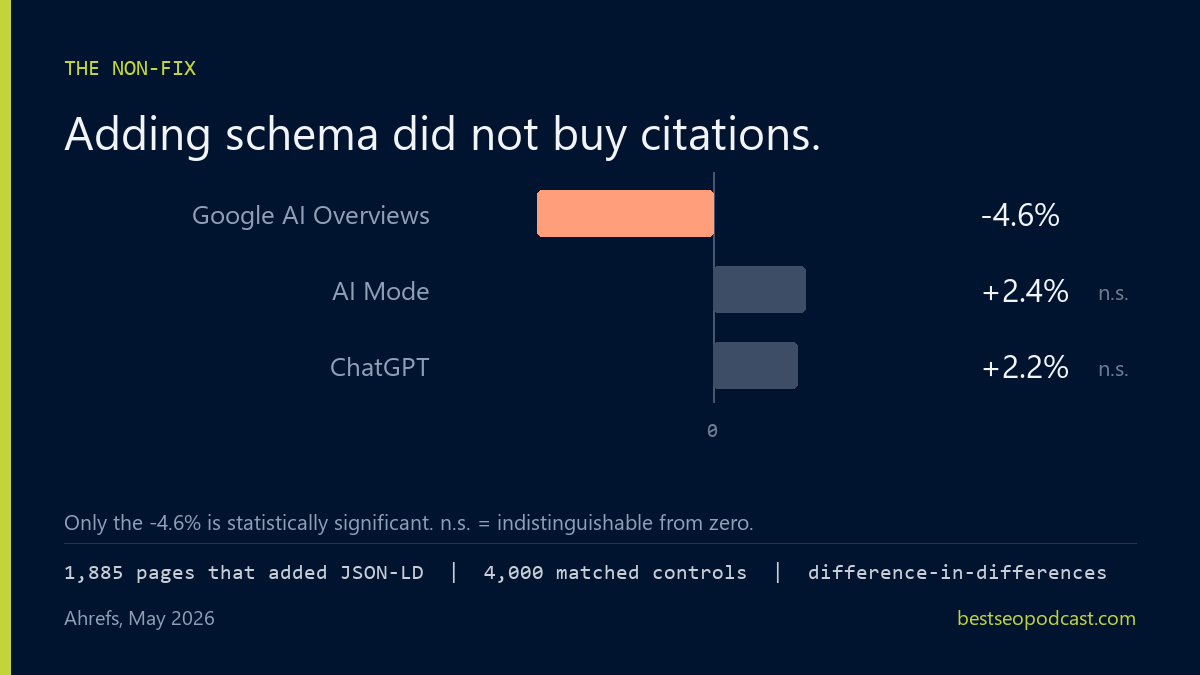
Here is one we would rather not report. Structured data, the technical markup commonly sold as an AI-visibility service, does not appear to drive AI citation. The best available test, a matched-control experiment by Ahrefs across 1,885 pages against 4,000 controls, found no gain. Citations moved 4.6% down in Google's AI Overviews, and the readings for AI Mode and ChatGPT were too small to distinguish from no change at all. This matters to us because our agency sells schema work, and we are telling you it does not do the thing it is most often sold to do.
AI Overview citations after adding structured data
AI Mode and ChatGPT: no distinguishable change
relayed
Ahrefs matched-control study (1,885 pages against 4,000 matched controls)
The tested pages were already heavily cited. The study shows markup will not push an already-cited page higher; it does not test whether markup helps an uncited page get discovered.
Our interest in this: EWR Digital, which produces this course, sells structured data implementation. We are reporting a result that argues against buying it for this purpose.
Every course like this has an incentive problem. The people writing it usually sell the services it recommends. The only way to be useful is to publish the findings that go against the author, so this lesson leads with ours.
Structured data, also called schema markup, is code added to a page that labels what things are: this is a product, this is its price, this is a review score. It is widely sold as a way to get picked up by AI answers. The best available test of that claim is a matched-control experiment: take pages, add the markup to some and not to others, and compare. Ahrefs ran one across 1,885 pages against 4,000 matched controls, comparing each group against its own prior performance. Citations in AI Overviews went down 4.6%. The readings for AI Mode and ChatGPT came out slightly positive, at 2.4% and 2.2%, but small enough that the study treats them as indistinguishable from no change. So the honest summary is not "schema hurts you": it is that one measure moved down a little and the other two did not really move, which is what a technique with no effect looks like.
Now the scope, which is as important as the finding, and is a limit rather than a walk-back. "No measured citation effect" is not the same as "useless". Structured data does real work elsewhere: it is how a search engine reliably knows your opening hours, your prices, your review scores and which entity you actually are, and it is what produces the enhanced results with stars and prices in the listing. Those are worth having. What the evidence does not support is buying it as a lever to get cited in AI answers.
The study's authors state a further limit, and we repeat it because leaving it out would overstate our own case. The pages they tested were already heavily cited. So the experiment shows that adding markup will not push an already-cited page higher. It does not test whether markup helps a page with no citations at all get discovered in the first place. That question is open, and anyone who tells you it is settled in either direction is going beyond the evidence.
Note also what we did not measure ourselves. The citation experiment above is Ahrefs' work, relayed here with a link, not ours. Our corpus measures which sources engines cite. It does not run controlled tests on individual techniques, so we cannot tell you from our own data what causes a citation. Anyone who tells you they can should be asked what their control group was.
The general principle behind the specific finding: on this surface, almost nothing that is purely technical has been shown to cause citation. What correlates with being cited is being the kind of source that was already worth citing. That is slower and less purchasable than a markup project, which is precisely why the markup project is easier to sell.
Takeaway: Ask what the control group was. No control, no causal claim.